iWild Casino KYC: Verification, Documents and Withdrawal Checks
 Available in US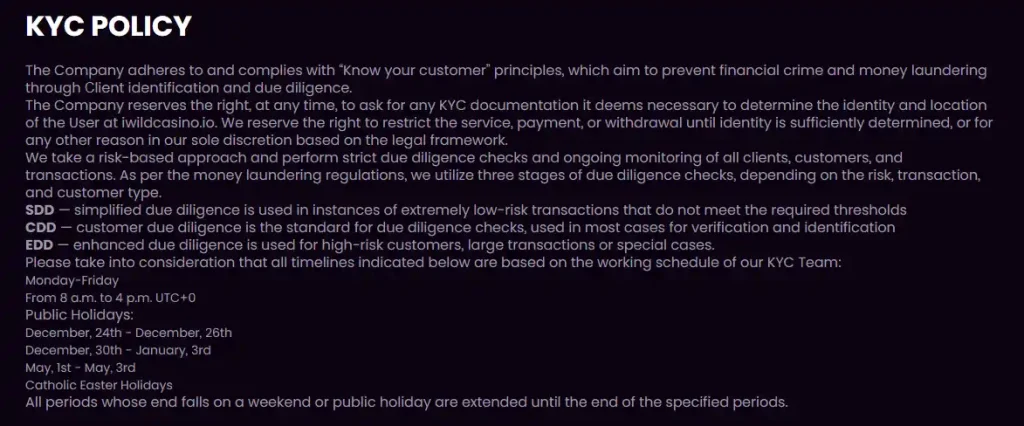
iWild may request KYC depending on account and withdrawal checks. What you should not assume is a fixed document list or a guaranteed verification time. The exact evidence required can depend on what the casino needs to confirm, and those requirements should be taken from the current instructions sent to your account rather than copied from an old review or another player’s case.
The best preparation is to keep your registration details accurate, use payment methods connected to you, retain clear records of relevant transactions and respond through official account or support channels if verification is requested. KYC can affect a withdrawal because a pending cashout may need account checks to be completed before funds are released. Preparing early reduces avoidable back-and-forth without pretending that every user will follow the same verification path.
Table of Contents
- What KYC means for an iWild account
- When can verification become relevant?
- Do not rely on a fixed iWild document list
- Make sure your account details match
- How to prepare verification material safely
- There is no dependable fixed verification time
- Why a withdrawal can involve more than identity checks
- What to do if more information is requested
- Protect personal data during KYC
- KYC and trust are related, but not identical
- If verification is delaying a withdrawal
- iWild KYC FAQ
- Recommend
What KYC means for an iWild account
KYC stands for know your customer. In practical terms, it is an identity and account-verification process used to confirm that the person controlling an account matches the information attached to it and, when relevant, the payment activity connected to it. iWild may request KYC depending on account and withdrawal checks.
That does not mean every account is asked for the same evidence at the same moment. A review can be triggered in different circumstances, and additional questions can arise if information does not line up cleanly. The useful takeaway is to expect that the details supplied at iWild registration may eventually need to be supported by legitimate evidence.
Verification should therefore be treated as part of account administration, not as a surprise that only matters after a withdrawal is delayed.
When can verification become relevant?
For iWild, KYC can become relevant around account checks and withdrawals. A player may be able to register, deposit and play before a later request asks for identity or payment-related confirmation. That is why completing earlier transactions successfully does not guarantee that a future cashout will bypass verification.
A withdrawal is a common point at which inconsistencies become more important. The casino may need to reconcile the account holder, payment ownership and transaction history before releasing funds. If a review is opened, the practical priority is to respond accurately and keep a record of what was requested and when it was supplied.
Our withdrawal guide explains the cashout sequence separately. KYC is one possible stage within that process, not the same thing as the payment method itself.
Do not rely on a fixed iWild document list
A fixed, universal list of iWild KYC documents is not safe to publish as though it applies to every account. Verification requests can change, and the evidence needed can depend on the issue being checked. If iWild asks you to verify, follow the current request attached to your account or communicated through an official channel.
As general preparation, online account verification can involve categories such as proof of identity, proof of address or evidence connected to a payment method. These are common verification categories across financial and gambling services, not a promise that iWild will ask every player for each one. Additional evidence can also be requested where a specific transaction or account detail needs clarification.
The important distinction is between preparing sensibly and guessing the operator’s requirements. Prepare legitimate, current records, but do not send extra sensitive documents that were never requested simply because an internet checklist says they are standard.
Make sure your account details match
Many verification problems are easier to avoid at registration than to repair later. Names, addresses and contact details should be entered accurately. If your account uses an abbreviated name, an old address or a typo that does not match your legitimate records, a reviewer may need additional clarification.
Payment ownership matters for the same reason. Using a payment method that clearly belongs to the account holder creates a cleaner link between the account and the transaction. Using someone else’s payment instrument can introduce questions about ownership even if the initial deposit technically succeeds.
If a legitimate detail changes after registration, use the account’s official update process or support route rather than opening a second account to work around the mismatch. Multiple accounts can create a separate set of account-control issues.
How to prepare verification material safely
- Read the exact request before preparing anything and note which information must be visible.
- Use clear, current records rather than cropped or edited files that hide required details.
- Check that names and addresses are consistent with the information on the casino account.
- Keep personal documents on a device or storage location you control.
- Use only the official account area or a support route reached from the legitimate casino environment.
- Do not send identity documents through social media, unofficial messaging accounts or an address supplied by an unknown third party.
- Keep a private note of the date you submitted material and what the request asked for.
- If a document is rejected, read the reason before repeatedly submitting different versions.
These steps do not guarantee approval, but they make the process easier to follow and reduce the risk of sending sensitive information unnecessarily.
There is no dependable fixed verification time
Do not plan a withdrawal around a single guaranteed KYC deadline. Public pages and individual cases can quote different timeframes, while account-specific reviews can take longer when more information is required. A quoted processing window can also refer only to one stage of a broader review.
If timing matters, separate three events in your own notes: when verification was requested, when you supplied the requested material, and when the casino acknowledged or changed the status. That produces a clearer record than measuring everything from the original withdrawal request.
If the stated review period shown in your current account or instructions has passed, contact support with concise details. Include the account identifier requested by support, the date of submission and the current status, but do not post sensitive documents publicly.
Why a withdrawal can involve more than identity checks
A cashout review can involve more than confirming a name. Payment ownership, transaction consistency and game-related checks can sit alongside KYC. This is one reason a completed identity step does not always mean that a withdrawal is immediately finished.
Current complaint material shows that iWild users can encounter KYC requests around withdrawals, but an individual complaint should not be treated as the casino’s universal policy. One person’s requested evidence, sequence or delay may reflect circumstances specific to that account.
The practical rule is to distinguish your own account status from anecdotes. Use complaints to understand the kinds of friction that can occur, not to predict the exact document request or timeline you will receive.
What to do if more information is requested
An additional request does not automatically mean the first submission was ignored. A reviewer may need a clearer copy, a more current record or information that resolves a mismatch. Read the new request closely and respond to that request rather than resending every file you have.
If you do not understand why something is needed, ask support to clarify the requirement before sending unrelated sensitive material. Keep the conversation focused on what must be verified and which submission channel should be used.
Where a payment method is involved, check whether the requested evidence concerns ownership, a particular transaction or another account detail. Those are different questions, and the clearest response is the one that addresses the actual issue without exposing unnecessary information.
Protect personal data during KYC
KYC documents can contain some of the most sensitive information connected to an online account. Treat them accordingly. Never publish them in a complaint forum, social post or public review, even if you are frustrated with the verification process. A public dispute can be explained without exposing an identification number, full address, card details or a document image.
Be cautious with messages that create urgency and ask you to send documents outside the normal account or support flow. If a request looks unusual, navigate to the casino independently rather than following an unexpected link, then contact support from there.
Keep your own copies and a record of correspondence, but store them securely. Once the verification issue is resolved, review whether any temporary copies remain in downloads folders, shared devices or unprotected cloud locations.
KYC and trust are related, but not identical
The existence of verification is not by itself proof that a casino is safe, locally licensed or suitable for an Australian player. KYC is one operational control. Broader trust questions include who operates the service, which domain is covered by any licence, how complaints are handled and whether the legal position is clear for the player’s location.
For those broader questions, see the iWild safety and reputation and the separate iWild licence. Keeping these topics separate prevents a routine identity request from being mistaken for evidence of Australian regulatory approval.
If verification is delaying a withdrawal
- Check the current account status and the latest request before contacting support.
- Confirm that every requested item was sent through the correct official channel.
- Record the submission date and any response or status change.
- Ask whether anything remains outstanding instead of assuming the review is complete.
- Keep the withdrawal request, transaction details and support correspondence organised.
- Avoid cancelling and recreating transactions repeatedly unless the casino instructs you to do so.
If the issue becomes a broader payment dispute, use the evidence trail you have kept to explain the sequence clearly. Dates, status messages and concise correspondence are more useful than a long description without a timeline.
iWild KYC FAQ
Does iWild require KYC?
iWild may request KYC depending on account and withdrawal checks. The exact trigger can vary, so do not assume that a successful deposit means verification will never be requested later.
Which documents does iWild require?
There is no fixed document list that should be treated as universal for every iWild account. Follow the current verification request you receive. General preparation can include legitimate identity, address or payment-related evidence, depending on what needs to be confirmed.
How long does iWild verification take?
A single guaranteed timeframe should not be assumed. Use the current instructions and status shown for your account, and keep a record of when requested material was submitted.
Can KYC delay an iWild withdrawal?
Yes. KYC can become part of account and withdrawal checks, so a cashout may remain unresolved while required verification is still outstanding.
Where should I send verification documents?
Use the official account area or a support channel reached from the legitimate casino environment. Do not send sensitive material to an unverified third party or post it publicly.
For the broader overview, see the full iWild review.